Search
Results
Admissions
Become a student at COTC.
Angela Simmons
The Sky is the Limit for COTC Nursing Graduate
When Angela Simmons graduated with a nursing technology degree from Central Ohio Technical College (COTC) in 2003, she knew she wanted to help save lives in her community. Simmons didn’t realize then that she would help open and manage a medical service facility that could be the difference between life and death for patients in Licking County. ”Air Evac Lifeteam opened a base in Licking County in 2012 after a local fire chief pointed out the lack of timely access to helicopter patient transports in the region,” said Simmons.
College Credit Plus Options A & B
Welcome to Central Ohio Technical College. It is our privilege to be a part of your educational journey. We are excited you have chosen to participate in Ohio’s College Credit Plus program and are taking advantage of the opportunity to earn both high school and college credit giving you a jump start toward your future. You will be assigned an advisor as a resource to assist you in answering questions, scheduling classes and guiding you through this college experience.
Frequently Asked Questions
What is the difference between being an Architectural Engineer and being an Architect?
Architectural Engineers focus on a building’s structural design to ensure it meets building codes and is sturdy and functional. Architects focus on designing a building’s look and style.
How quickly can I complete the Architectural Engineering Technology program?
Students can complete the Architectural Computer Aided Drawing (CAD) Certificate in just two semesters!
After completion of the Architectural CAD Certificate, students are well on their way to completing the Architectural Engineering associate degree.
The amount of time it takes a student to complete the Architectural Engineering Technology associate degree depends upon how many courses are taken per semester.
Students who attend full-time (and take 3-5 classes on average per semester) will complete quicker than students who attend part-time (and take 1-2 classes on average per semester).
What classes do I need to take?
The courses students need to take to complete a certificate or degree are listed in a Plan of Study. The Civil Engineering Technology Program has two Plans of Study.
Can I take classes online or face-to-face?
Students at COTC have the flexibility to take classes face-to-face or online. The Civil Engineering Technology program has courses that must be completed face-to-face for students to learn through hand’s-on experience and using equipment and technology in the Engineering program.
Are there any student organizations on campus related to Engineering?
Society of Engineering Technology (SET)
Current students in any Engineering program can join The Society of Engineering Technology (SET), a student organization for both COTC and Ohio State Newark students. Students who are part of the SET can gain awareness of education and career opportunities available to their preferred engineering technology field. This may include the following but not limited to: Architectural, Civil, Mechanical and Electrical. Advisor: Whitney Tussing.
What type of financial assistance is available to help me pay for college?
COTC awards a million dollars in scholarship to students each year!
Students are encouraged to complete a Free Application for Federal Student Aid (FAFSA) to be considered for grants, scholarships and loans.
Students who complete a FAFSA are automatically considered for some scholarships. Other scholarships require an application.
Connect with Student Financial Services at 740.366.9435 or email: NWK-studentfinancialservices@mail.cotc.edu.
Are there scholarships specifically for Engineering?
Yes! Students who complete a Free Application for Federal Student Aid (FAFSA) are automatically considered and receive a $2,200 Engineering scholarship if they have a high school or college GPA of 2.0 or higher.
Can I pursue a bachelor’s degree after I complete an associate degree?
Students interested in continuing on to pursue a bachelor’s degree can consider transferring to a four-year college or university. COTC has several transfer agreements with four-year colleges.
- Miami University
- The Ohio State University – Engineering Technology
 COTC’s Associate of Science is designed to allow graduates to move seamlessly to bachelor’s degree programs at all state-supported colleges and universities in the state of Ohio, as well as at many private institutions. In fact, every course on the AS plan of study is fully transferable to any school that accepts the
 DMS Majors
Students can choose one of two majors in the sonography program at COTC: general or cardiovascular. All concentrations of the program are accredited by Commission on Accreditation of Allied Health Education Programs.
General Major
- Abdominal organs: liver, kidneys, spleen, pancreas, etc.
- Obstetrics and gynecology
- Breast, thyroid, prostate, etc.
- Musculoskeletal muscles and tendons
- Neonatal brain and pediatrics
Cardiovascular Major
- Adult heart
- EKG
- Cerebrovascular carotid arteries and brain
- Peripheral blood flow of vessels in arms and legs
- Abdominal arteries and veins
Is online learning right for me?
We understand that online classes may not be for everyone. Some learners prefer in-person connections with instructors and classmates. But, sometimes you may not be able to come to campus, or an online course may fit better with busy work and family schedules.
We want to assure you that our online campus provides the same academic rigor, expert instruction from seasoned faculty, opportunities to connect with classmates, and support services you’ll get when enrolled in face-to-face classes. Taking classes online may not be as bad as you think… in fact, it may help you reach your goals faster!
It might be helpful to highlight characteristics an online learner should possess.
- Are you a self-directed learner?
- Are you comfortable asking questions?
- Can you stay motivated?
If you answered yes, then you should be successful taking classes online.
What kind of technology do I need? What if I’m not very tech-savvy?
At a minimum, you will need to have access to a computer and a good, reliable internet connection. Most of today’s laptops or desktops should be just fine. We do not recommend relying solely on an iPad or other tablet for your school work. They’re great for taking notes, creating and annotating readings, but not as good for typing lengthy papers or using specialized software.
Similarly, while Chromebooks are a popular option for many students, they are not always compatible with specialized software that you may need for some classes. Check with your advisor or a faculty member first to be sure.
Of course, students with some existing technology skills will be able to better navigate the tools and systems that support online learning at COTC. If you’re unsure about your tech skills, take this online readiness assessment to learn more.
Do online classes cost more?
No, our online classes are covered by the same tuition and fees policies as other courses. You can learn more about the cost of a COTC education on this webpage.
As is the case with all major financial decisions, you should speak with a student financial services representative to understand costs of various programs, ways to pay for college, and how starting college may affect your personal financial situation.
How do I get started with online learning?
All COTC students will go through the same application and enrollment process.
Once you’ve chosen your program of study and completed your orientation, you can begin scheduling online classes (if available). You’ll need to meet with your academic advisor to discuss which classes to take and in what order.
You can recognize online classes in our course catalog by looking for an “N” in the section number (e.g., DMD-103-NA) and a computer/globe icon near the course title (  )
)
The “locations” column will also give you information about the format of the course. You’ll notice that we have a variety of options available, including face-to-face, live Zoom video sections, classes offered in both formats and, of course, classes that you complete on your own schedule. Again, we recommend speaking with your academic advisor about which courses are right for you.
Student Planning
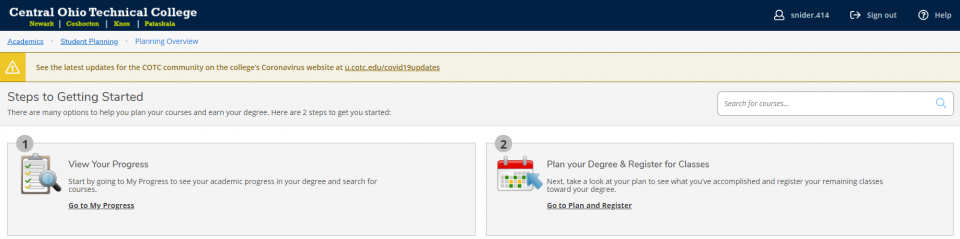
Student Planning is an online tool that makes managing your course planning easier!
You can use Student Planning to track your progress toward your degree or certificate, plan your class schedule, and register for classes.