Search
Results
Julio Valladares
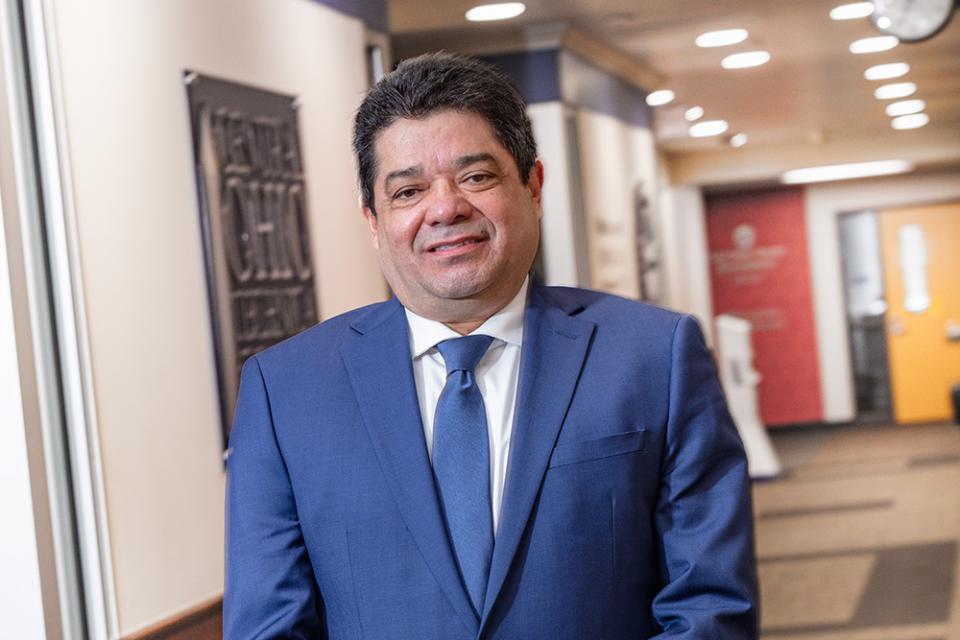
A trip to Newark in 1981 with the El Salvador National Baseball Team was 19-year-old Julio Valladares’ first experience in the place he would later call home.
While his native country was in the midst of a civil war, Valladares felt a sense of peace and welcome in the home of his host family, who gladly opened their doors to him six months later when he decided to move to the United States.
Program Outcomes
Upon completion of the electrocardiograph technician program, the graduate will be able to:
- Demonstrate knowledge of human body structure, function and pathology.
- Demonstrate knowledge of cardiac electrophysiology.
- Demonstrate completion of appropriate diagnostic studies including but not limited to EKG, ECG, telemetry.
- Correctly identify basic rhythms, lethal rhythms and artifacts.
Jane Camlin-Tammen Family Reserve
Policies and Procedures
This document describes the policies and procedures for use of the Camlin-Tammen Reserve. This property consists of 31 acres of mature forest growth and is located west of the campus on Country Club Drive in Newark, Ohio. This property is owned by Central Ohio Technical College but will be used to support teaching and research as a land laboratory for both COTC and The Ohio State University at Newark.
CCP Eligibility
The state of Ohio requires students to show some level of college readiness to be eligible to participate in College Credit Plus (CCP). The CCP Eligibility rule for the school year 2022-2023 has been expanded and went into effect February 13, 2022.
Per the state of Ohio, a student is eligible for the College Credit Plus program if the student meets any of the following criteria:
- Obtains a remediation-free score on one of the standard assessment exams (Accuplacer, ACT, SAT);
- Has a cumulative unweighted high school grade point average of at least 3.00;
- Has a cumulative unweighted high school grade point average of at least 2.75 but less than 3.00 and received an “A” or “B” grade in a relevant high school course.
Note: COTC defines relevant coursework as high school level Math or English (non-remedial courses). Other coursework may be considered as relevant for entrance into technical education courses and will be assessed on a case-by-case basis.
Once a student interested in CCP at COTC has applied to the college and requested official transcripts be sent to COTC, an Admissions Representative will review the student for CCP eligibility.
After it is determined a student is eligible to participate in CCP, students must still meet COTC course requirements and prerequisites. COTC course requirements may vary depending upon the subject and in some cases a student may need to complete placement testing.


Frequently Asked Questions
How quickly can I complete the criminal justice technology program?
The amount of time it takes a student to complete the criminal justice technology associate degree depends upon how many courses are taken per semester.
Students who attend full time (and take 3-5 classes on average per semester) will complete quicker than students who attend part time (and take 1-2 classes on average per semester).
Can I take classes online or face-to-face?
Students have the flexibility to take classes face-to-face or online. Some classes in the criminal justice program require hands-on learning and are only offered face-to-face.
Are there any age requirements to take classes in Criminal Justice Technology (CJT)?
Students must be 18 to enroll in the LET 107 Basic Handgun course.
What type of financial assistance is available to help me pay for college?
COTC awards more than $1 million in scholarships to students each year.
Every student is encouraged to complete a Free Application for Federal Student Aid (FAFSA) to be considered for grants, scholarships and loans.
Students who complete a FAFSA are automatically considered for some scholarships. Other scholarships require an application.
Connect with the Office of Student Financial Services at 740.366.9435 or email NWK-studentfinancialservices@mail.cotc.edu.
How do I get started at COTC?
Help us learn more about you by visiting our Future Students webpage, then follow the COTC Steps to Enroll to get started.
Knox Promise
Free College for Eligible Knox County Residents
COTC guarantees that tuition (instructional and general fees) will be entirely covered by institutional, federal and state aid as well as private scholarships for eligible students who reside in Knox County.